
5 Day Challenge from Apathy to Thriving
Reading time – 10 minutes
We live in a time that is busier and more distracting than ever before. That means it’s easy to develop habits that promote selfishness and self-interest over noticing others. Kindness is seen as weakness, rather than the mutually rewarding experience it truly is. Spending quality time with others and making connections are ways to improve mood and relieve stress. We are meant to connect.
Welcome to your five-day thriving experiment. It’s about consciously choosing kindness for yourself and others. By embracing generosity and a helpful nature, you can make a positive impact on your world and experience a shift in your perspective and well-being.

Day 1 – Breaking the Autopilot of Apathy
Technology can be hazardous. You have probably seen videos of people so engrossed in their devices that they lose all awareness of their surroundings. A common occurrence is neck pain and aching shoulders from poor posture while using technology. A person’s head is leaning forward with their face down, staring at their device. This has become so common and chronic that health authorities have given it a name. Text neck. Also known as the smartphone slump, it can lead to the following symptoms.
- Headaches
- Shoulder and neck pains
- Blurred vision
- Numbness or tingling in the fingers
In many cases, people aren’t intentionally being unkind. They are merely distracted and unaware, failing to notice what’s going on around them. Awareness is the first step toward kindness, for both ourselves and others. You can foster compassion by first practicing intentional awareness of the people you interact with.
- Pay attention.
- Put down your devices.
- Engage in the real world.
- Connect with others, even if only for a moment.
You begin to appreciate your world when you become more aware of it.
Day 1 Exercise: The One-Minute Notice
Take one minute to look up, make eye contact, or verbally acknowledge three people you usually overlook today (a cashier, coworker, delivery driver, etc.). Write down how each moment felt: awkward, natural, energizing?

Day 2 – Redefining Strength
Some people equate kindness with weakness. It is anything but a display of weakness. Kindness is an aspect of a self-confident nature.
Responding with courtesy in a calm, measured manner shows control. There is power in a calm, measured response to those life events that make you feel pressured. You are being kind toward yourself when you decide to master your emotions rather than letting them control you. Responding with thought and regard to someone’s feelings when they threaten to cause you to react negatively is a display of strength. Embracing kindness and composure is a strong character trait. They are signs of a confident person who doesn’t have to act brashly or loudly to demonstrate firm control over their emotions.
Day 2 Exercise: The Calm Response Test
Think of a common trigger (e.g., slow email replies, rude drivers, curt messages). When it happens today, pause, take one breath, and respond with calmness or courtesy. Record what changed in the interaction or in your mood.
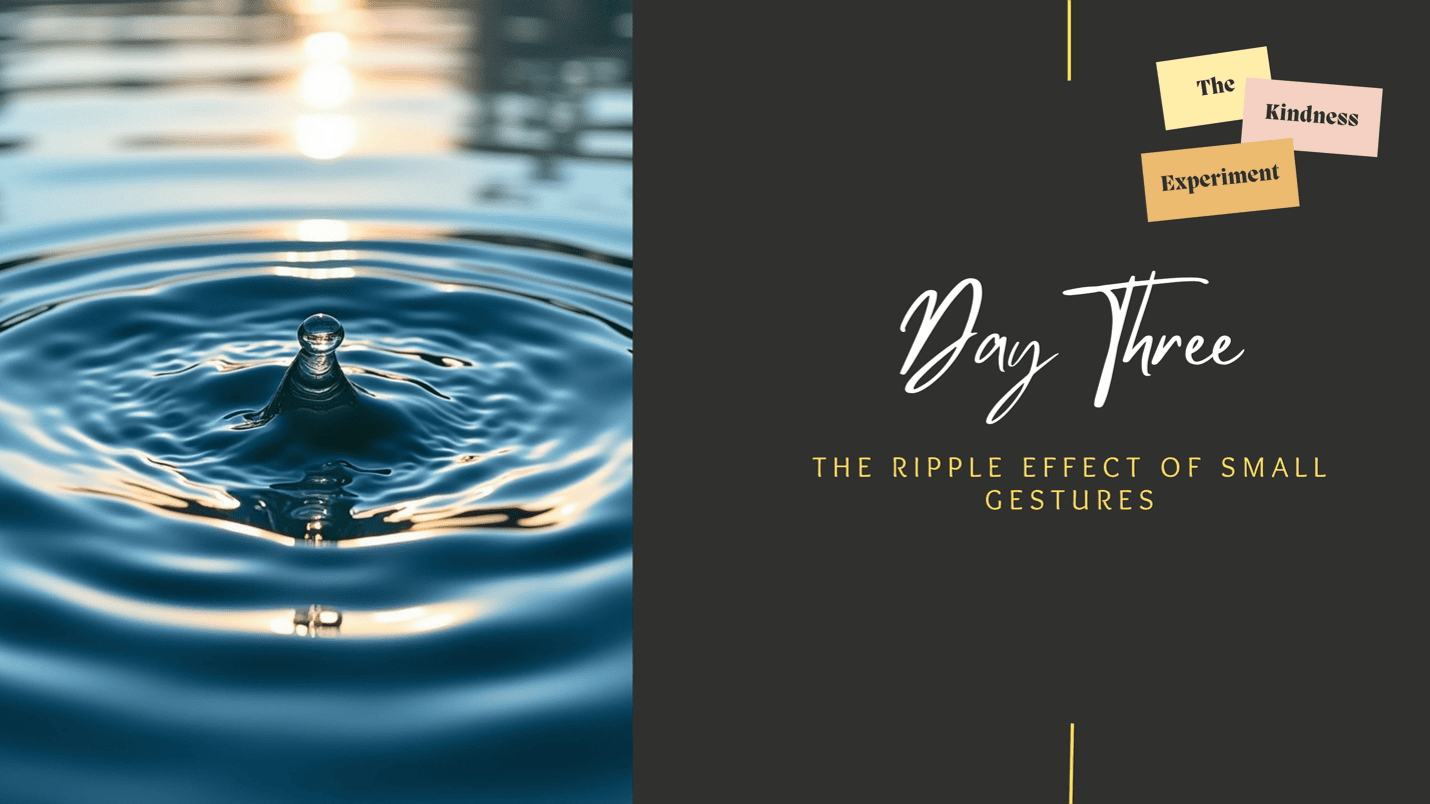
Day 3 – The Ripple Effect of Small Gestures
The concept of the ripple effect is simple-just as a small pebble can create ripples that spread across a pond, your small acts of kindness can have a significant impact on the world around you. All that is required are small and consistent actions.
Tiny acts of compassion and courtesy are easy to perform. You hold a door for someone whose hands are full. Compliment a person’s clothes or car. Pick up trash during your daily walk around your neighbourhood. Those small actions can have a significant impact. Perform them consistently, and they build on each other to help you connect with the world. They also foster a greater appreciation for yourself. A single small act of kindness or consideration can positively reset the energy in a room. Make acts of micro-kindness a regular habit, and you can shift the emotional tone in your environment. You create a win-win experience when you share a small act of kindness with another.
Day 3 Exercise – The 10-Second Lift
Today, spend 10 seconds giving someone a genuine compliment or thanks- something specific, not generic. Write down who you chose, their reaction, and how you felt afterward.

Day 4 – Choosing Humanity in High-Speed Spaces
Have you ever been in a noisy room where several people were talking? Most people raise their voices to be heard in that situation. Everyone is loudly clamouring to outdo the others so their voices will be heard. Sometimes the most powerful voice is quiet. A person quietly and methodically speaks when everyone else is screaming. This is a proven way to attract attention. You communicate calmly and quietly, and others will stop talking and intensely listen to what you have to say.
Slow down to stand out when life is speeding by you. Give your undivided attention to the present moment. Minimize your distractions. Consciously choose to engage with the here and now. Be fully present, and you show respect for yourself and anyone you connect with. Choose to slow down and connect with intention rather than running through your personal interactions.
Day 4 Exercise: The Full-Attention Conversation
Choose one short interaction today (in person or online). Put away your phone, silence notifications, and listen fully. Ask one follow-up question that shows genuine interest. Write down what felt different.

Day 5 – The Experiment Lives On
You have been taking action to this point in your experiment. It is just as necessary to review the results of your actions. Then, you can tailor your future actions to deliver the desired result. Today, on this final day of your thriving experiment, we ask you to examine the results you have created.
- How have others responded to your kindness?
- How does it feel to slow down and be present in your interactions?
- Is it possible for you to sustain habits of kindness long-term?
- Can you live this way?
Look back over the previous four days and see what has changed. You will notice that even with the smallest acts of kindness, energy can change quickly. You can positively shift the energy in your environment by confidently acting courteously and responding with measured responses.
Make small, intentional acts of consideration part of your daily routine. They can help you improve your personal and professional experiences. Reacting calmly and measuredly in a stressful situation is also a kind way to treat yourself. Practice awareness and intent. Choose to spread kindness and consideration, and you will find those experiences returned to you.
Day 5 Exercise: The Pay-It-Forward Promise
Write down one act of kindness you’ll commit to doing within 24 hours , something specific and straightforward (send an encouraging message, help someone out, express gratitude). Do it today and note how it made you feel.
We don’t want to survive. We want to thrive. These 5 actions will help you to connect with people so you can continue to grow, learn and appreciate the world around you.
More Blogs On Thriving to Enjoy
 Julie Stobbe is the 2024-2025 winner of the Harold Taylor Award for outstanding contributions to the organizing industry and Professional Organizers in Canada. As a Trained Professional Organizer and Lifestyle Organizing Coach, she brings happiness to homes and organization to offices, coaching you virtually using Zoom. She has been working with clients since 2006 to provide customized organizing solutions to suit their individual needs and situations. She uses her love of teaching to reduce clutter, in your home, office, mind and time. She guides, mentors and supports you to be accountable for your time, to complete projects and to reach your goals. If you’re in a difficult transition Julie can coach you to break-free of emotional clutter constraining you from living life on your terms. Online courses are available to help instruct, coach and support your organizing projects. Get started by downloading Tips for Reorganizing 9 Rooms.
Contact her at julie@mindoverclutter.ca

This challenge really speaks to me — it’s so easy to get caught up in our own busy lives and forget to notice the people next to us. I’m going to try the 5-day reset this week and see what shifts.
Thank you for your comment. It is so easy to get caught up in life and having a goal to slow down and reevaluate schedules and habits can be used to refocus relationships.