
15 Minute Reset
Reading time – 15 minutes
The 15-Minute Reset
A Repeatable Mini Routine You Can Use Daily to Feel Better and Get Moving
A Quick Note Before We Begin
“The journey of a thousand miles begins with a single step.”
— Lao Tzu
This report is for you if you are busy, feeling stuck, running on low energy, overwhelmed by everything on your plate, or struggling to find motivation. If you have ever looked at your to-do list and felt paralyzed, or spent an afternoon knowing you should be doing something but unable to start, you are in the right place.
What you are about to learn is a simple, repeatable process that helps you reset your state and create a small win. It works by restarting forward motion, not by forcing you to suddenly feel inspired or energized. The core promise is this: you do not need to feel inspired, motivated, or ready. You just need 15 minutes.
That is all. Fifteen minutes to shift your mood, take one meaningful action, and break the pattern of being stuck. This is not about fixing everything. It is about getting unstuck, right now, with what you have.
Introduction
“You do not rise to the level of your goals. You fall to the level of your systems.”
— James Clear
Fifteen minutes is the sweet spot between too short and too long. It is small enough that you can do it on your roughest days, when everything feels impossible. Even when you are exhausted, stressed, or convinced you cannot focus, you can commit to 15 minutes. That low barrier is essential because the hardest part of getting unstuck is starting.
At the same time, 15 minutes is big enough to genuinely change your direction. You can shift your emotional state, complete a small task, and create real momentum. It is not a token gesture. It is a legitimate reset that produces tangible results.
This reset has two goals. First, improve how you feel, even a little. You do not need to go from miserable to ecstatic. Moving from a two to a four on your internal scale is a genuine win. Second, create momentum with one small action. When you are stuck, the path forward feels blocked. Completing one small task proves the path is open and makes the next action easier.
“An object at rest stays at rest unless acted upon by an outside force.”
— Isaac Newton
Start by doing one reset today. Do not try to memorize everything or perfect your approach. Just follow the steps once and see how it feels. Then repeat daily for a week. Consistency reveals patterns. You will notice which mood shifts work best for you, which tasks create the most momentum, and what time of day you need the reset most. After a week, customize the process based on what you have learned.

The Two-Part Reset Framework
“Almost everything will work again if you unplug it for a few minutes, including you.”
— Anne Lamott
Every effective reset follows a simple two-part structure. Understanding this framework helps you adapt the process to any situation.
The first five minutes focus on shifting your internal state. This is not about solving your problems or fixing your life. It is simpler than that. You are changing how you feel right now, in this moment. A brief physical movement, a quick mental reframe, or a small environmental change can shift your state enough to make action possible. You are not aiming for transformation. You are aiming for a slight improvement that opens a door.

The next ten minutes turn that shift into action before your brain talks you out of it. This is critical. Feeling slightly better creates a window of opportunity, but that window closes quickly. Your old patterns, doubts, and resistance will reassert themselves if you wait. By immediately channeling your improved state into a concrete task, you convert a temporary mood shift into real progress.
“If you have an impulse to act on a goal, you must physically move within five seconds or your brain will kill the idea.”
— Mel Robbins
Keep this rule in mind throughout every reset: start simple, make it doable, finish the 15 minutes. Do not overcomplicate the process. Do not choose tasks that are too ambitious. And always complete the full 15 minutes, even if you feel like stopping early. Finishing builds trust with yourself and reinforces the habit.
The Core 15-Minute Routine
“Between stimulus and response there is a space. In that space is our power to choose.”
— Viktor Frankl
Before you begin, take one minute to identify what you need most right now. Pick one target: calm, energy, clarity, confidence, or focus. Do not overthink this. Your gut reaction is usually correct. If you are anxious, choose calm. If you are sluggish, choose energy. If you are scattered, choose clarity or focus. If you are dreading a task, choose confidence. Naming your target helps you select the right mood shift activities in the next steps.
Spend two minutes on simple physical movement. Walk to another room and back, do some basic stretches, or shake out your arms and legs. The movement does not need to be intense. You are waking up your body and interrupting the stuck pattern. If possible, drink a glass of water or step outside for a breath of fresh air. These small physical actions signal to your brain that something is changing.
Now use a quick mental prompt to shift your perspective. Pick one of these questions and answer it honestly: What is one thing that is going right? What would make the next hour easier? What is the smallest helpful action I can take? These questions redirect your attention from what is wrong to what is possible. You do not need a profound answer. Even a simple response starts to change your mental orientation.
Select a single small task that you can start immediately. This task must be specific, visible, and small. Specific means you know exactly what to do. Visible means you can see progress or completion. Small means you can make meaningful progress in seven minutes. Examples include sending one email, clearing one section of your desk, writing one paragraph, or completing one form. If you struggle to choose, pick the easiest option available.
Set a timer for seven minutes and work on your micro-task with full attention. No multitasking. No checking your phone. No switching to something else. If you finish before the timer goes off, either repeat the task, continue with a closely related task, or prep the next tiny step. The goal is to stay engaged in productive action for the full seven minutes.
Spend the final minute writing one sentence that acknowledges your progress and identifies what comes next. Use one of these formats: I moved forward by… followed by what you accomplished, or Next step is… followed by the next small action. This closing ritual is essential. It converts your work into a documented win and sets up your next move. Skipping this step diminishes the psychological benefit of the reset.
SummaryThe core routine follows six steps: · Choose a reset target · Do a two-minute physical reset · Use a mood boost prompt · Select one micro-task · Sprint for seven focused minutes · Close the loop with one written sentence. Start simple, stay focused, finish all fifteen minutes. |
Build Your Reset Menus
“The secret to happiness is low expectations.”
— Barry Schwartz
Decision fatigue kills momentum. When you are already struggling, having to figure out what to do makes everything harder. The solution is to create pre-built menus so you never have to think.
List 10 fast options for shifting your mood. Include a variety of approaches: movement activities like walking or stretching, music that energizes or calms you, environment changes like opening a window or changing rooms, simple social connections like sending a quick text to a friend, and quick gratitude practices like naming three things you appreciate. Keep all options under five minutes and requiring no special preparation.
List 10 fast options for productive micro-tasks. Include small administrative tasks, cleaning one micro-zone of your space, sending a single email, outlining one section of a larger project, or planning tomorrow’s priorities. Each item should be completable in seven to ten minutes with visible progress.
Your menu rules:
- No item should require setup or special equipment
- Every option must be available right now, exactly as you are
- If an option requires you to already feel somewhat motivated, remove it
- Test each item once before it earns a permanent spot
No item on either menu should require setup, special equipment, or a perfect mood. Every option must be available right now, exactly as you are. If an option requires you to find something, go somewhere special, or already feel somewhat motivated, remove it from the list.
The 5 Most Common Problems and Quick Fixes
“Everyone has a plan until they get punched in the mouth.”
— Mike Tyson
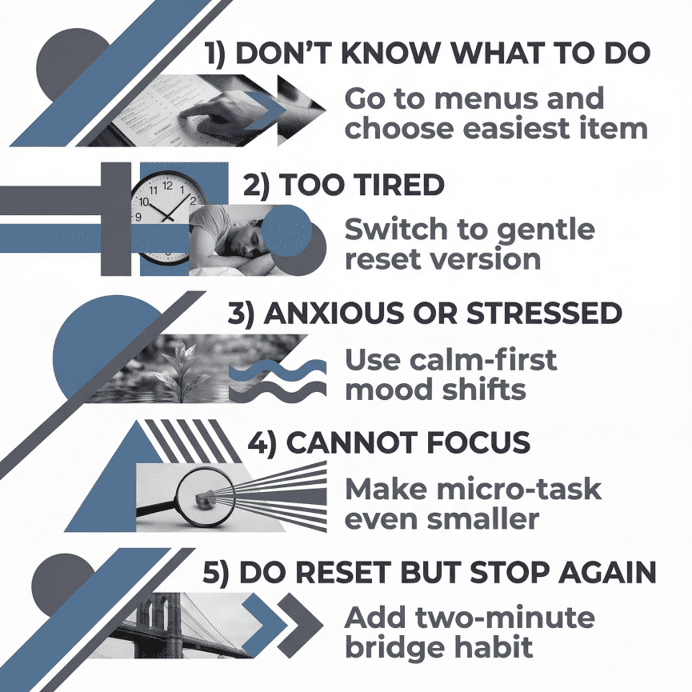
If you feel paralyzed by options or cannot identify a task, go straight to your menus and choose the easiest item on the list. Do not evaluate, compare, or second-guess. The point is to move, not to optimize. Any action beats no action.
If you are too tired, switch to a gentle reset version. For the mood shift, choose the calmest, lowest-energy options. For the micro-task, pick something you can do while sitting or that requires minimal mental effort. Lower the bar as much as necessary. A gentle reset still counts.
If you are anxious or stressed, use calm-first mood shift options. Slow breathing, a brief walk outside, or a few minutes of gentle stretching work better than energizing activities when you are already activated. Do not try to pump yourself up. Bring yourself down first, then proceed with the momentum portion.
“Anything worth doing is worth doing badly.”
— G.K. Chesterton
If you cannot focus, make your micro-task even smaller than usual. Remove all distractions from your immediate environment. Commit to just a three-minute start instead of seven minutes. Often, getting started is the only barrier. Once you begin, focus tends to follow.
If you do the reset but stop again, add a two-minute bridge habit immediately after the reset. This could be reviewing your calendar, checking off the task you completed, or setting a timer for your next work block. The bridge connects your reset momentum to your next activity and prevents the common pattern of completing a reset and then drifting back into stuck mode.
Make It a Daily Habit Without Overthinking
“We are what we repeatedly do. Excellence, then, is not an act, but a habit.”
— Aristotle
The best default is to schedule your reset at the same time every day, typically mid-morning or early afternoon when energy naturally dips. Consistency helps the reset become automatic. However, you should also use it as a backup whenever you notice yourself feeling stuck, regardless of the time.
Choose a reset spot that you can access reliably. This might be your desk, your kitchen, a spot outside, or even your car. Having a consistent location creates a mental trigger and reduces friction. You know where to go when it is reset time.
“Make it easy. Make it fit. Make it grow.”
— BJ Fogg
Tie the reset to something you already do every day. After your morning coffee, before lunch, after your first meeting, or when you first log into your computer. This anchoring technique uses existing habits as triggers, which dramatically increases follow-through compared to relying on memory or willpower alone.
Upgrade Paths
“Adapt what is useful, reject what is useless, and add what is specifically your own.”
— Bruce Lee
Once you have mastered the core 15-minute routine, you can customize it for specific situations. Here are four variations to add to your toolkit.
Use the gentle reset on low energy days. For the mood shift, choose the softest options: slow stretching, calming music, or quiet breathing. For the momentum portion, select the easiest possible task from your menu. Success here is simply completing the 15 minutes without pushing yourself. Sometimes maintaining the habit matters more than maximizing output.
Use the confidence reset before an important call, presentation, or challenging task. For the mood shift, focus on power poses, energizing movement, or recalling past successes. For the momentum portion, do a quick preparation task related to the upcoming challenge, such as reviewing notes or writing down your opening line. End with a clear statement of your intention for the upcoming task.
The four reset variations at a glance:
- Gentle Reset: lowest energy options, easiest task, just finish the 15 minutes
- Confidence Reset: power-up activities, prepare for a specific challenge
- Stress Reset: calming first, then organize rather than produce
- Productivity Reset: high energy start, tackle the one task you have been avoiding
Use the stress reset when overwhelmed by too much to do. For the mood shift, prioritize calming activities that lower your activation level. For the momentum portion, focus on organizing rather than doing. Make a list, prioritize three items, or simply clear your workspace. The goal is to create a sense of control, not to accomplish major tasks.
Use the productivity reset when procrastinating on something specific. For the mood shift, use high-energy options to build activation. For the momentum portion, focus exclusively on starting the task you have been avoiding. Define the absolute smallest first step and do only that. Often, the hardest part of procrastinated tasks is simply beginning.
Conclusion
“The only person you are destined to become is the person you decide to be.”
— Ralph Waldo Emerson
After a week of daily resets, most people notice three changes. First, less stuck time. The periods where you feel paralyzed or unable to act become shorter because you have a tool to interrupt them. Second, quicker recovery. When you do get stuck, you bounce back faster instead of losing hours or entire days. Third, more follow-through. Completing small tasks builds confidence in your ability to take action, which makes larger tasks feel more manageable.
Do one reset tomorrow. Pick a time, set a reminder if needed, and follow the six steps. Use the mood boost prompts and choose the simplest micro-task you can think of. After you finish, write your closing sentence. That is all you need to do to start. One reset, one day at a time, until the 15-minute routine becomes your automatic response to feeling stuck.
You do not need to feel ready. You do not need to be motivated. You just need 15 minutes.
I think I have covered it all. Let me know what I missed. What’s important to you?
 Julie Stobbe is the 2024-2025 winner of the Harold Taylor Award for outstanding contributions to the organizing industry and Professional Organizers in Canada. As a Trained Professional Organizer and Lifestyle Organizing Coach, she brings happiness to homes and organization to offices, coaching you virtually using Zoom. She has been working with clients since 2006 to provide customized organizing solutions to suit their individual needs and situations. She uses her love of teaching to reduce clutter, in your home, office, mind and time. She guides, mentors and supports you to be accountable for your time, to complete projects and to reach your goals. If you’re in a difficult transition Julie can coach you to break-free of emotional clutter constraining you from living life on your terms. Online courses are available to help instruct, coach and support your organizing projects. Get started by downloading Tips for Reorganizing 9 Rooms.
Contact her at julie@mindoverclutter.ca